 Alle News
2023: Three new AI institutes at Cyber Valley
Celebrating ten years of Cyber Valley in 2026

In 2016, important actors from science, industry, and politics founded the Cyber Valley Consortium, which became the first Innovation Campus in Baden-Württemberg. Ten years on in 2026, we're revisiting the most significant milestones from the last decade. Each month, we'll focus on a particular year since Cyber Valley's beginning.
This month, we’re looking back to 2023, when three new AI institutions within the Cyber Valley Innovation Campus were founded: the Institute for Artificial Intelligence at the University of Stuttgart, the Tübingen AI Center, and the Center for Bionic Intelligence Tübingen Stuttgart. Since 2023, these institutes have played a key role in advancing Cyber Valley’s mission: turning excellent AI and robotics research into a better future for all. Below, we recount why these institutes were established, their main achievements, and their future plans.
Center for Bionic Intelligence Tübingen Stuttgart (BITS)
The Center for Bionic Intelligence Tübingen Stuttgart (BITS) was founded to establish a new approach for integrating intelligent technical systems with humans. It aims to improve understanding and treatment of certain neurological and psychiatric diseases and develop individually tailored medical aids for patients. BITS brings together scientists from four institutions: the Universities of Stuttgart and Tübingen, and the Max Planck Institutes for Intelligent Systems and for Biological Cybernetics.
Since its founding in 2023, its main achievements include new in-body agents that can be controlled inside living animals to stimulate movement behavior and novel on-body soft devices to suppress the shaking body in tremor patients. The latter received the 2025 innovation prize of the German Parkinson Foundation. In the future, BITS will go beyond medical devices to investigate and develop hybrid cybernetic control-loop systems that closely integrate humans and technology, including in the fields of ergonomics and occupational health and safety research.
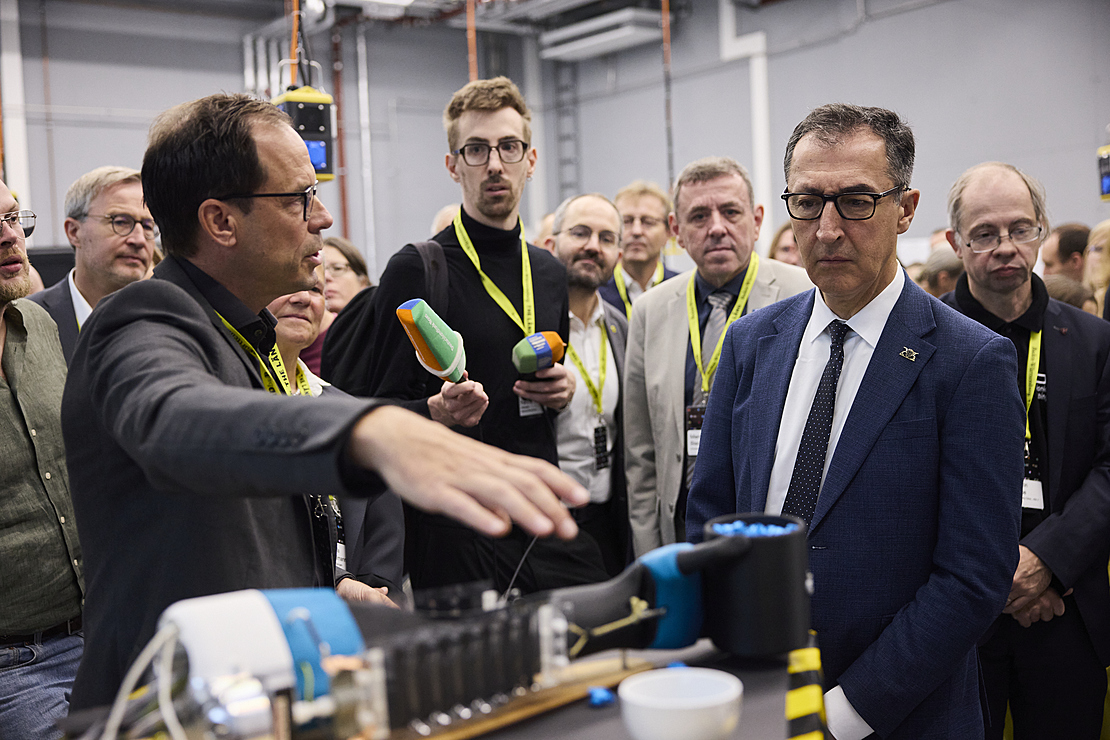
BITS at Cyber Valley Day on September 9, 2026. Photo: Christian Borth
The Institute for Artificial Intelligence, University of Stuttgart
The Institute for Artificial Intelligence at the University of Stuttgart was founded to undertake internationally outstanding AI research while supporting its transfer for the benefit of industry and society. The Institute also aims to reflect on AI’s societal impact by monitoring AI and ensuring AI compliance through joint research with industries, the humanities, and social sciences.
Since 2023, the Institute has celebrated several important milestones. By drawing on physical principles, the Institute has created more reliable machine learning models that have applications in molecular and materials simulations. Moreover, PhD student Bo Xiong won the award for the best computer science dissertation of the German-Austrian-Swiss Association for Computer Science. Meanwhile, the Institute’s spin-off company, Semanux GmbH, is helping those with motor disabilities to participate in the digital sphere without support of third parties.
In the future, the Institute plans to develop reliable AI methods that support scientists and engineers. It will accelerate the discovery of new drugs and materials, while developing new engineering products. A further goal is to enable non-experts to adapt and co-design robotic systems that they work and interact with.
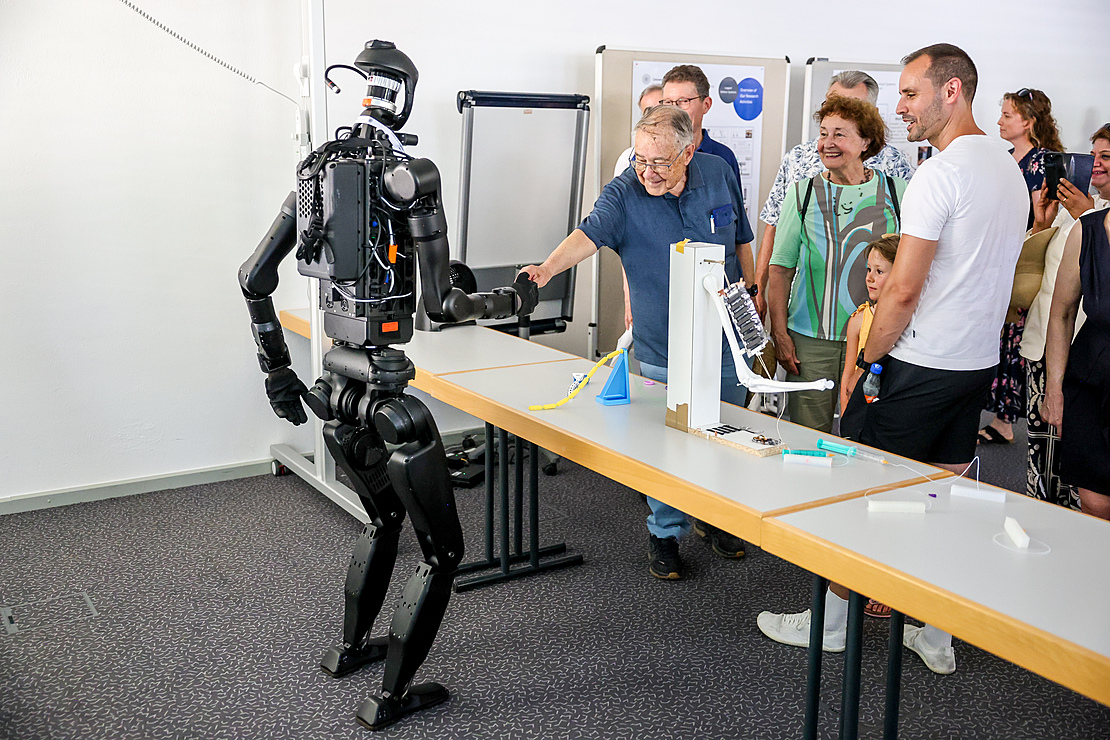
Institute of Artificial Intelligence, University of Stuttgart. Photo: Universität Stuttgart/Uli Regenscheit
Tübingen AI Center, University of Tübingen
In 2023, the Tübingen AI Center at the University of Tübingen was established as a permanent national AI center. The Center aims to shape the next generation of machine learning and develop more robust, efficient, and accountable learning systems.
Since its establishment as a national AI competence center, the Tübingen AI Center has played a key role in strengthening the region’s research and innovation ecosystem. It has brought together more than 300 scientists across 32 research groups and has established strong links between research, education, and entrepreneurship. Its growing technology transfer activities have helped turn research into products, tools, and start-ups.
Looking ahead, the Center plans to appoint more professors and increase its transfer activities even further. Recent spin-offs, including two Tübingen-affiliated teams selected for SPRIND’s Next Frontier AI program in 2026, and several focused research organizations, illustrate what this may entail.
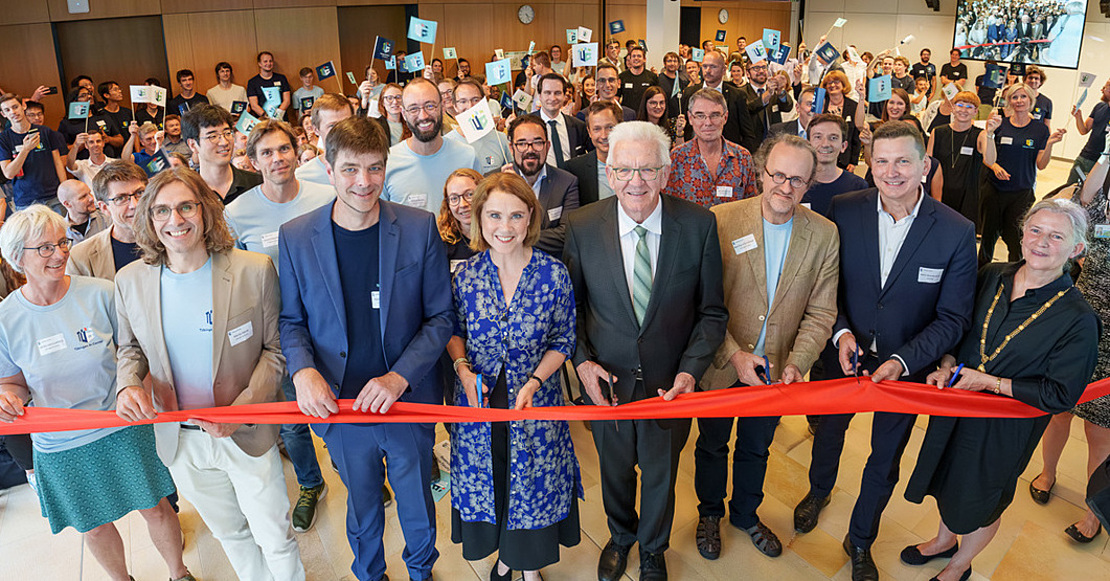
Inauguration of the Tübingen AI Center, Photo: Wolfram Scheible
To celebrate Cyber Valley's ten-year anniversary, we'll be sharing a variety of content across our website and social media channels reflecting on milestones from the last decade. Stay tuned for the next installments!
Zugehörige Artikel


Three start-ups join the Cyber Valley Start-up Network


Visualization tools for learning to play a musical instru...